The Service Trap
Why Academic Goodwill Doesn't Compound
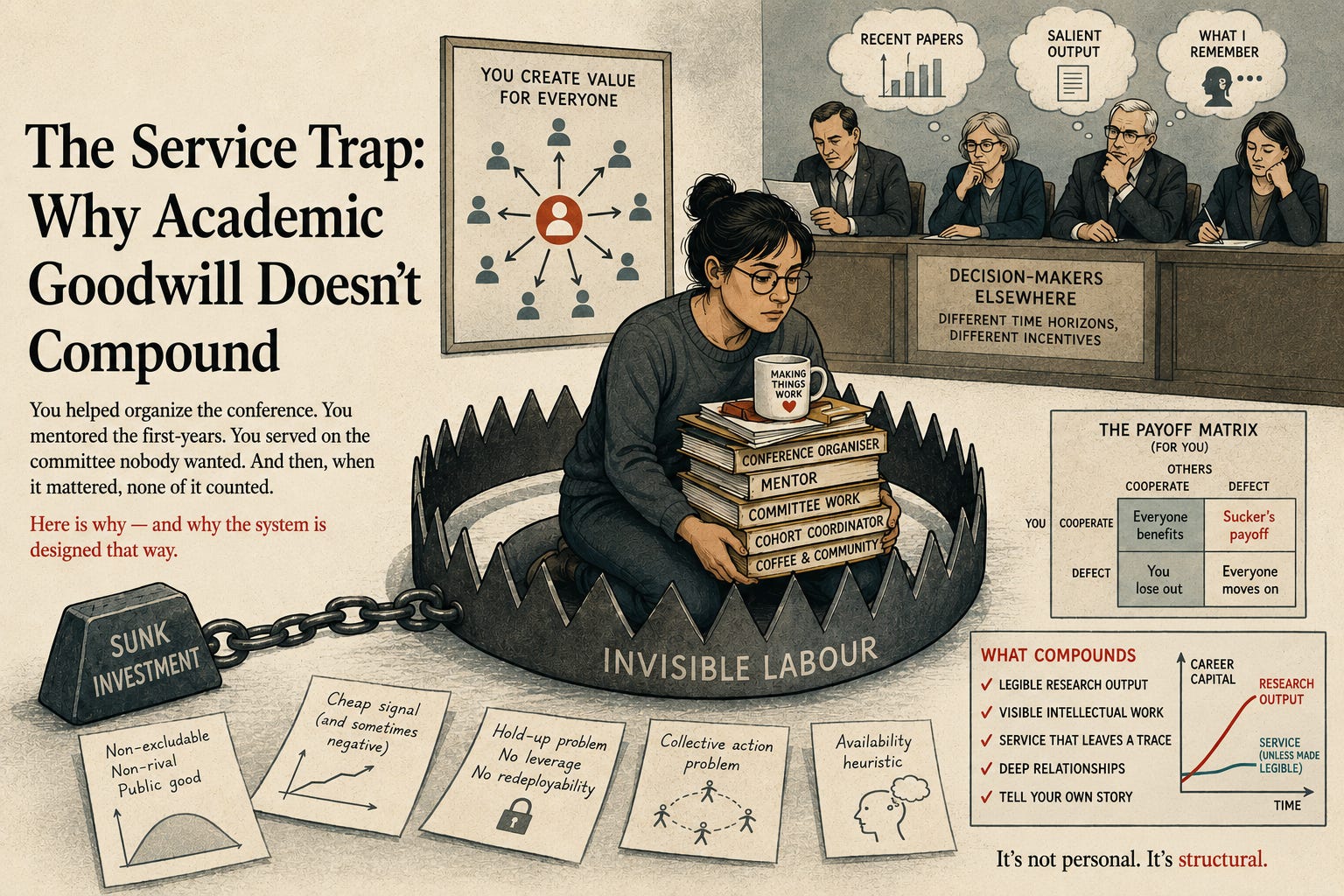
You helped organize the conference. You mentored the first-years. You served on the committee nobody wanted. And then, when it mattered, none of it counted. Here is why — and why the system is designed that way.
There is a rite of passage in academia that nobody warns you about.
You arrive as a PhD student, eager, socially attuned, perhaps mildly anxious to belong. You notice that the department runs on invisible labour — someone has to book the seminar rooms, coordinate the reading groups, show up early to set out the coffee. You do these things willingly, even enthusiastically. It feels right. It feels like investment. Somewhere in the back of your mind, a quiet calculation is running: I am building credit here. This will matter later.
It will not matter later.
This is not a complaint about ingratitude, nor a cynical verdict on human nature. It is something more interesting and more structural: a set of interlocking economic mechanisms that make the academic context almost uniquely hostile to the conversion of social capital into career capital. Understanding these mechanisms does not make the experience less frustrating. But it does transform it from a personal wound into a legible institutional pathology — and that shift in framing is, at minimum, more useful.
The Credit That Cannot Be Collected
The first mechanism is what economists call the externality problem, and it operates quietly in almost every department.
When a PhD student invests in the social life of a department — organising events, being the glue that holds a cohort together, volunteering on committees — the benefits of that investment diffuse outward to everyone. Colleagues enjoy a more collegial environment. Junior students feel more supported. The department as a whole functions better. These are real benefits, and they are genuinely produced by the student’s effort.
But here is the problem: the people who absorb those benefits are largely not the people who will later decide whether the student gets a postdoc recommendation, a fellowship endorsement, or a position on the shortlist. Those decision-makers are often elsewhere, operating on different time scales, and they face no particular cost for failing to reward the contributions they never directly witnessed. In the language of economics, your social investment is non-excludable (you cannot restrict who benefits) and non-rival (one person benefiting does not reduce another’s share). These are the hallmarks of a public good — and public goods, left to individual incentives, are chronically undersupplied and systematically under-rewarded.
You produced a public good for your department. The market for public goods does not pay well.
The Problem With Being Nice
There is a second mechanism, more uncomfortable to name but perhaps more important: adverse selection in signalling.
In economics, a signal is only useful if it separates types — if it is costly enough that only the people who genuinely have the underlying quality will invest in it. Publications, in this sense, are (imperfect but real) signals of research ability: they are hard to fake, externally validated, and costly to produce. Service and sociability, by contrast, are cheap signals. They are available to anyone regardless of their intellectual contribution. A brilliant researcher who is also warm and collegial looks, from a distance, exactly like a weak researcher who compensates with charm.
Worse: heavy investment in service can shade into a negative signal in the eyes of some senior evaluators. The implicit reading is not flattering — this person evidently has time for this — which raises questions about the research pipeline. This is not a fair inference, and it is often wrong. But it is a predictable one, given how senior academics allocate their own attention and how they have learned to read the revealed preferences of junior colleagues.
The cruelty here is specific to the early career stage. A tenured professor who serves on university committees is demonstrating institutional citizenship from a position of security. A PhD student who does the same is, structurally, doing something that reads differently — and the reading is not always charitable.
The Hold-Up Problem, or: Why You Had No Leverage
Transaction cost economists have a concept called the hold-up problem, first formalised by Oliver Williamson and developed further by Klein, Crawford, and Alchian in the 1970s. It describes a situation where one party makes a relationship-specific investment before the terms of exchange are secured — and is then exposed to exploitation because the investment cannot be redeployed.
Classic examples involve physical capital: a supplier who builds a factory tailored to a single buyer’s specifications, only to find that the buyer can now renegotiate the price at will, because the factory is worthless to anyone else. But the logic applies with painful accuracy to the PhD student who invests in social integration.
Once you have built a reputation as the helpful, engaged, collegial member of the department, that investment is sunk. It cannot be taken elsewhere. It has no value on the external market. And crucially, senior colleagues — not through any particular malice, but simply through the structure of the situation — have no credible incentive to ensure reciprocation. You have already delivered. There is nothing left for them to secure. The terms of the implicit exchange, which were never written down precisely because they felt too obvious to require writing, are entirely in their favour by the time decisions are made.
This is why the feeling of betrayal that accompanies this realisation is so acute. It is not paranoia. The asymmetry is real. It was baked into the situation from the beginning.
Everyone Benefited, No One Paid
The third mechanism is the most structurally fundamental: a collective action problem of the classic kind that Mancur Olson described in The Logic of Collective Action (1965).
The department, as a collective, benefits from having socially engaged, service-oriented PhD students. The seminars run better. The atmosphere is more generative. The junior students are better mentored. These are genuine, diffuse gains. But no individual senior faculty member has a specific incentive to personally ensure that the student who produced those gains is rewarded for them. Each can reason, quite rationally, that someone else will take care of it, or that the system will recognise it, or simply that it is not really my job.
The result is a multi-player prisoner’s dilemma in which the contributing student is left in what game theorists call the sucker’s payoff — the cell in the payoff matrix occupied by the one player who cooperated while everyone else defected. The tragedy is compounded by the fact that none of the defectors need feel like defectors. They are simply doing what the institutional incentive structure asks of them: advancing their own research agendas, writing their own papers, serving on the committees that advance their own careers.
Institutions, as Olson observed, do not solve collective action problems automatically. They require selective incentives — mechanisms that make individual contribution worth the individual cost. Academic departments, for all their sophistication, rarely have those mechanisms in place for PhD-student service. The culture of recognition is thin, the memory is short, and the feedback loop between contribution and reward is so attenuated as to be functionally broken.
We Forget, Systematically
There is a behavioural dimension too, less celebrated in the economics literature but no less real.
Senior academics who make career decisions — recommendation letters, shortlist opinions, grant endorsements — are not drawing on a comprehensive ledger of everyone’s contributions. They are drawing on a much thinner dataset: recent interactions, salient publications, and whatever narrative about the candidate is most readily available in memory. Daniel Kahneman’s work on the availability heuristic is relevant here: we judge frequency and importance by how easily examples come to mind, not by how accurately we have tracked the underlying base rate.
A paper published last year is available. A committee you served on three years ago is not. The conference you helped organise is not. The first-year student you mentored informally is not. These contributions are not suppressed by bad faith; they are suppressed by the ordinary cognitive economy of busy people making judgements under time pressure.
The PhD student, meanwhile, is operating under what behavioural economists call projection bias — the tendency to assume that others share your current values, time horizon, and sense of what matters. You remember every contribution you made because you made it. You assume it is similarly salient to others. It is not, and the asymmetry in memory is not correctable by goodwill alone.
What To Actually Do About It
None of this is an argument for becoming a bad colleague or withdrawing from the social life of your department. Departments that function well are better environments to develop in, and your contribution to that — even if it goes unrewarded — has genuine value. The people you mentor informally will remember you. The relationships you build may matter in ways that are non-linear and hard to predict.
But there is a distinction worth drawing sharply: between contributions you make because you value them intrinsically, and contributions you make because you expect them to compound into career capital. The former is fine and even admirable. The latter is a systematic miscalculation, and the economics are clear about why.
So here is the practical translation — not cynical, but clear-eyed.
Treat your time budget as a portfolio. Research output is your equity: it appreciates, it is portable, and it is legible to every evaluator you will ever encounter. Service is a current expense — valuable in the moment, but it does not carry forward on any balance sheet that decision-makers consult. A rough rule of thumb: if a service commitment cannot be finished in a few hours, ask yourself whether the same time invested in a paper section would serve your five-year self better.
Make your intellectual work visible early and often. Present at every internal seminar you can. Circulate working papers. Comment publicly on others’ work in workshops — not to perform, but to establish a track record of intellectual engagement that senior colleagues actually witness firsthand. Visibility in research contexts is the one form of impression management that survives the availability heuristic.
Choose service that leaves a trace. Not all service is equal in its legibility. Organising a coffee rota leaves no trace. Co-organising an external conference, editing a special issue, or serving as a discussant for a high-profile seminar creates an artefact — a programme, a publication, a record — that can appear in a CV and be pointed to at the moment of decision. If you are going to invest in service, invest in the kind that converts into something attributable.
Build relationships deliberately, not diffusely. The hold-up problem is most severe when your social investment is spread across the entire department with no particular depth anywhere. A small number of senior scholars who know your work well — who have read your drafts, attended your talks, engaged with your ideas — are worth far more than a wide network of people who simply like you. Depth beats breadth when letters of recommendation are being written.
Name your contributions when the moment arrives. Academic culture discourages self-promotion, which means that the people who most need their contributions remembered are also the least likely to mention them. This is a costly norm to internalise. When updating your CV, when meeting with your supervisor, when being introduced to an external evaluator, make your service contributions part of how you describe yourself — briefly, factually, without apology. Do not assume others are keeping the ledger. They are not.
What compounds in academia is output that is attributable, durable, and legible at the moment of decision. Publications survive institutional forgetting. A reputation for intellectual rigour, built through visible work, survives it too. Pure service, warmth, and social glue largely do not — not because they are less valuable, but because the institutions that would need to remember them are not structured to do so.
The tragedy is that this is a genuine market failure. The academic department, as a community, wants the thing that it systematically fails to reward. The fix is institutional — formal recognition of service in promotion criteria, mentorship logs that enter evaluation processes, department cultures that make collective goods visible at the moments when they count. Most departments do not do this. Until they do, the most honest advice for the idealistic early-career scholar is both blunt and kind: contribute because you want to, not because you expect it to be remembered. Navigate accordingly. The system has a short memory. It is not personal. It is structural.