When Politicians Stop Making Sense — And Nobody Notices
On the quiet collapse of logical reasoning in public discourse
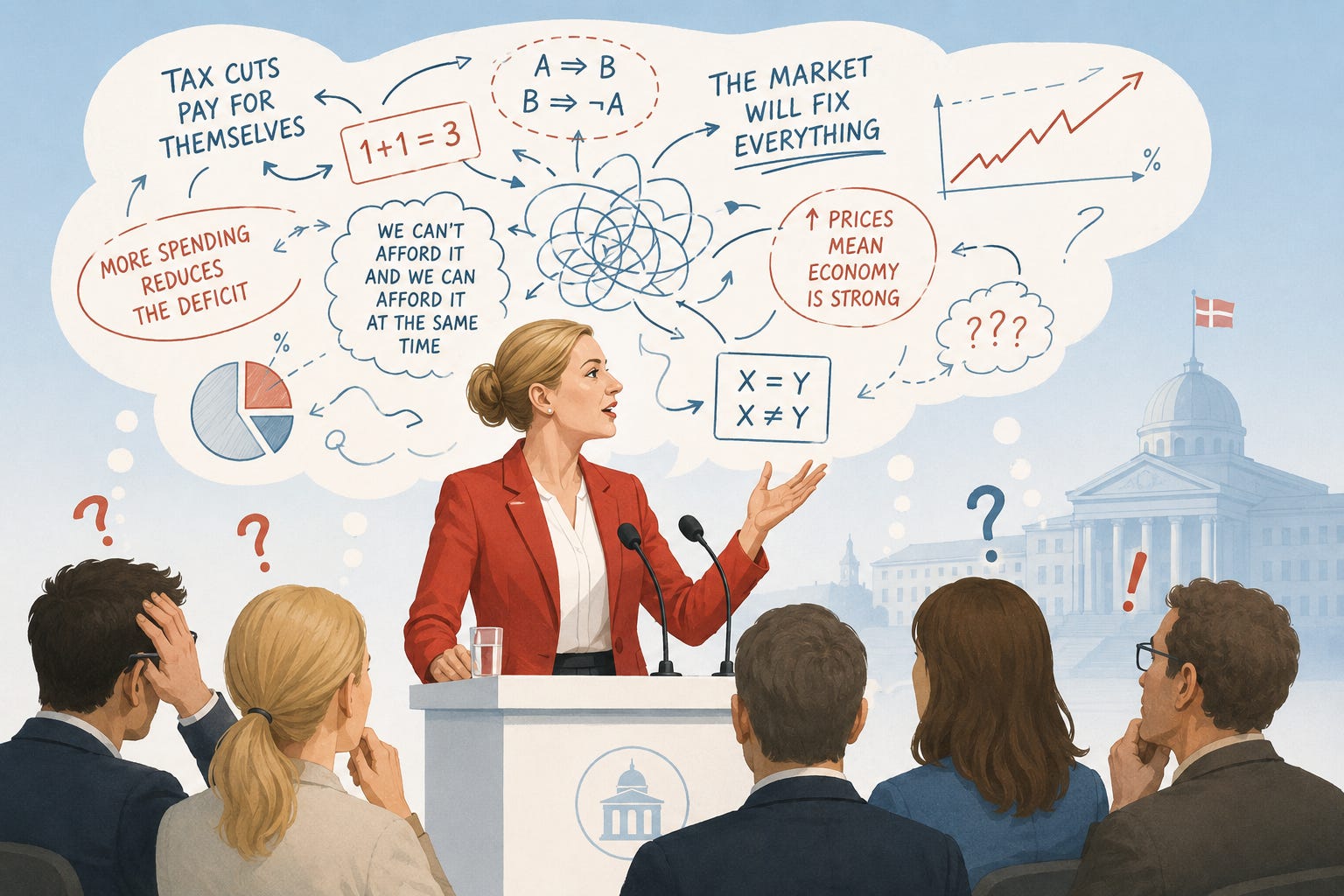
There was a time when entering politics required at least a passing acquaintance with the art of making an argument. You needed to be able to construct a sentence, follow a chain of reasoning to its conclusion, and — crucially — notice when your own logic had gone off the rails. That time, if it ever truly existed, appears to be behind us.
What we are witnessing across Western democracies is not merely a decline in the quality of political debate. It is something more fundamental: a growing tolerance for statements that are not just wrong, but structurally incoherent — claims that fail not at the level of evidence, but at the level of basic logic. And what is perhaps most alarming is not that politicians make such statements. It is that almost no one calls them out for it.
A Gallery of the Incoherent
Politicians have always stretched the truth. But there is a meaningful difference between a politician who exaggerates a statistic and one who makes a claim that is self-contradictory on its face.
Consider the genre of statement that has become depressingly familiar: the politician who argues simultaneously that a problem is so severe it demands emergency action and that their policies have already solved it. Or the official who insists that a spending programme will “pay for itself” through growth — while also insisting that the very same growth proves the programme is unnecessary. Or the leader who warns of the dangers of foreign interference in elections while actively soliciting it.
These are not nuanced positions that require unpacking. They are logical contradictions. Yet they pass through press conferences, parliamentary debates, and television studios largely uncontested. The journalists move on. The opponents seize on the optics rather than the reasoning. The public, exhausted, scrolls past.
The standard has dropped so far that we have almost ceased to notice.
The Rubin Case: A Masterclass in Muddled Thinking
The most favoured and obviuos case for illustrating the issue is to be found in the current American presidency (You-Know-Who) and his administration. But lets use a different example for the sake of novelty. Indeed, lets consider a statement recently made by the Danish politician Monika Rubin for a particularly vivid illustration of how badly political logic can go wrong and how little it tends to matter.
Rubin was commenting on a genuinely troubling phenomenon: a pattern of Danish police shelving rape cases, with the problem apparently more pronounced in certain regions — specifically, on the island of Funen — than in Copenhagen. This is a real and serious issue that deserves serious engagement.
Her conclusion, however, was remarkable. She logically deduced from the forwarded regularities that she would rather be raped in Copenhagen than on Funen, given the differential likelihood that her case would actually be investigated.
Let us be precise about why this is not merely an unfortunate turn of phrase, but a logical failure.
Rubin was presumably trying to make a point about institutional accountability — that the Copenhagen police are more likely to pursue rape cases than their counterparts on Funen. That point, if true, is worth making. But the conclusion she drew from it is inverted. What follows from the observation that cases are more likely to be shelved on Funen is not that one would prefer to be victimised there — a preference no rational person could hold — but rather that a perpetrator would find Funen more operationally convenient. The calculation of “where would I rather this crime happen to me” yields a nonsensical result; the calculation of “where would a criminal find less institutional resistance” is the coherent version of the argument.
Put plainly: if you are trying to highlight institutional failure in a region, the logical statement is “I would rather commit the crime on Funen, if I were a criminal seeking impunity.” Not “I would rather be the victim there.” These are opposite positions. One is a critique of the system; the other is a bizarre expression of victim preference that makes no sense at all.
The statement should have been immediately challenged. It was not a matter of political interpretation — it was simply wrong in its internal logic. That it apparently passed without significant scrutiny is itself the story.
So Why Does This Keep Happening?
The charitable explanation is simple incompetence. Some politicians are not very bright, or speak before they have finished thinking, or have communications teams that care more about soundbites than coherence. This is doubtless part of the answer.
But it is not the whole answer. When a phenomenon is as widespread and persistent as this one, it rewards a more systematic explanation. Economics, perhaps surprisingly, has several to offer.
Public Choice Theory: The Incentives Are All Wrong
Public Choice theory, developed by economists such as James Buchanan and Gordon Tullock, applies the tools of economic analysis to political behaviour. Its central insight is that politicians are rational actors responding to incentives — and the incentives in democratic politics are not well aligned with the production of careful, logical argument.
Voters do not, on average, reward logical rigour. They reward emotional resonance, tribal affiliation, and the appearance of conviction. A politician who says something confused but passionate will often outperform one who says something precise but dry. The market for political ideas does not clear on the basis of logical quality; it clears on the basis of emotional impact.
Moreover, the costs of making an illogical statement are low. Most voters will not notice. Journalists are under time pressure and may lack the specialist knowledge to identify the error. Opponents may prefer to score political points in other ways. In this environment, the rational politician has little incentive to invest in careful reasoning — and considerable incentive to invest in memorable, emotionally charged rhetoric, even if it makes no strict logical sense.
The Attention Economy and the Clickbait Effect
Modern political communication does not take place in the measured environs of parliamentary debate. It takes place on social media platforms optimised for engagement — which is to say, optimised for outrage, surprise, and emotional intensity.
In this environment, a provocative or unusual statement — even a deeply confused one — generates attention. Monika Rubin’s statement about preferring to be raped in Copenhagen almost certainly attracted more coverage than a carefully worded, logically coherent analysis of regional variation in Danish police case closure rates would have done. From a pure attention-maximisation standpoint, the illogical statement worked.
This creates a perverse dynamic. The very features that make a statement logically problematic — its exaggeration, its inversion of normal reasoning, its emotional register — are the features that make it travel. The attention economy does not penalise incoherence. In many cases, it rewards it.
Adverse Selection: The Wrong People in the Room
Adverse selection, a concept from information economics, describes the process by which, under conditions of imperfect information, lower-quality actors tend to crowd out higher-quality ones. The canonical example is the used car market: because buyers cannot distinguish good cars from lemons, they are only willing to pay average prices, which drives owners of good cars out of the market, leaving a higher proportion of lemons.
Something similar may be occurring in democratic politics. The conditions of modern political life — the media intrusion, the social media abuse, the salary compression relative to comparable private sector roles, the brutal hours, the permanent public exposure — are increasingly unattractive to people with strong outside options. The highly capable lawyer, economist, or policy expert can earn more, suffer less, and exercise more genuine intellectual influence outside of politics than within it.
The result, over time, may be a political class that is increasingly selected against cognitive quality. This is not universal — there are still brilliant people in politics — but the structural pressures are real. And a legislature or cabinet that has been filtered, even partially, for willingness to tolerate degrading conditions rather than raw intellectual capacity will, on average, produce lower-quality reasoning.
Moral Hazard: No One Bears the Cost
Moral hazard arises when an actor does not bear the full consequences of their decisions and therefore takes more risk than they otherwise would. In financial markets, it explains why banks that expect to be bailed out take excessive risks. In politics, it helps explain why politicians make claims they could not sustain under scrutiny.
If a politician makes a logically incoherent statement and faces no meaningful consequence — no lost votes, no media censure, no damage to their career — they have no strong incentive to be more careful next time. The cost of logical failure has been externalised. It is borne by public discourse generally, by the quality of democratic deliberation, by the citizens who make decisions based on confused information — but not by the politician who introduced the confusion.
The absence of robust fact-checking institutions, the fragmentation of media, the collapse of a shared epistemic baseline — all of these reduce the likelihood that logical failures will be identified and penalised. Moral hazard thrives.
Game Theory: A Race to the Bottom
Finally, game theory illuminates how individually rational behaviour can produce collectively irrational outcomes. Consider a simple model: if Politician A maintains high standards of logical rigour while Politician B deploys emotionally resonant but incoherent messaging, and if voters respond more strongly to emotional resonance than to logical quality, then Politician B wins. Politician A, observing this, has an incentive to lower their own standards. The result is a Nash equilibrium in which all politicians converge on low logical quality, even though all of them — and certainly the public — would be better off if high standards were maintained across the board.
This is a coordination problem. Individual actors, responding rationally to the incentive structure, produce an outcome that no one would have collectively chosen. And like most coordination problems, it is difficult to escape without some external mechanism — robust institutions, a demanding press, an informed and demanding public — that changes the payoff structure.
What Is To Be Done?
This article has been more diagnostic than prescriptive, and deliberately so. The causes of political illogic are structural, not merely personal — they cannot be fixed by electing better individuals into a system that selects against rigour and rewards incoherence.
But a few observations seem worth making.
First, the press has a role here that it is not consistently filling. Pointing out that a politician’s statement is factually contested is now standard practice. Pointing out that it is logically invalid — that the conclusion does not follow from the premises, that the argument is internally contradictory — is rarer, and arguably more important. A claim can be factually accurate and still be a non sequitur. Journalists need the tools and the confidence to say so.
Second, citizens bear some responsibility too. The appetite for emotionally satisfying nonsense is not something that happens to electorates — it is, to some degree, something they participate in. A public that rewards clarity and penalises confusion at the ballot box would change the incentive structure for politicians overnight.
Third — and perhaps most importantly — we should stop treating logical incoherence in political speech as merely aesthetic, a matter of style or communication skill. When a politician makes a claim that is structurally invalid, they are not just speaking badly. They are contributing to an environment in which citizens cannot reason clearly about the choices in front of them. That is a democratic harm, not a rhetorical one.
Monika Rubin did not mean to say something absurd. She was trying to make a real point about a real problem. But the fact that her illogic went largely unchallenged is not a small thing. It is a symptom of a broader failure — of scrutiny, of standards, of the basic expectation that people who hold public power should be able to think clearly about the things they are speaking about.
That expectation seems worth recovering.